
Term 1 | Lecturer: Ps Mervin Jayaseela
Introduction#
In Session One, we chose to begin with a biblical perspective of manhood, because in today’s world there is widespread confusion and debate about what it means to be a man.
We learned that in the space between the creation of man and woman, the man’s purpose was to establish a foundation for his family and society. He was called to lead, teach, cultivate, provide, and protect.
Today, we examine how the male first failed in his assignment - and how that failure continues until a man chooses to declare: “I will be the man God created me to be.”
Adam’s Silence#
“And when the woman saw that the tree was good for food, and that it was pleasant to the eyes, and a tree to be desired to make one wise, she took of the fruit thereof, and did eat, and gave also unto her husband with her; and he did eat.” - Genesis 3:6 (KJV)
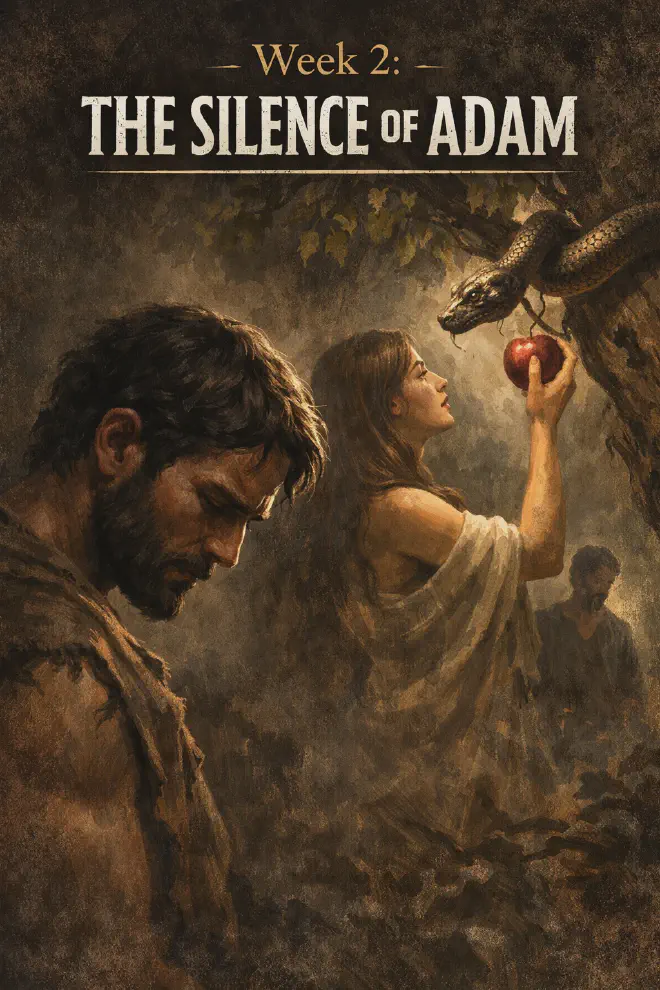
Why was Adam silent when his wife Eve took the fruit and ate it? He was present. He knew what she was doing was wrong.
This passage invites us to examine Adam’s silence during Eve’s temptation. Scripture highlights his passivity - he neither intervened nor spoke up - symbolising a failure to act.
Is this a reflection of the struggle many men face today when confronted with difficult moments, especially in relationships and spiritual matters? There is often a holding back, a silence born from a desire to preserve harmony and avoid conflict. This exposes the challenges men face in responsibility and relationship.
The call to be a foundation is a call to serve. Silence and passivity are often rooted in a paralysing fear of failure - an attack of the enemy aimed at destroying masculine courage, responsibility, and leadership.
For all intents and purposes, Adam abandoned his calling as a man and a husband. He did not speak. He did not intervene. He was meant to protect her, yet he failed to confront the threat that entered his territory. Instead, he allowed his wife to face the serpent’s onslaught alone - unprotected and unguarded.
What Was the Reason for Adam’s Silence?#
“And Adam was not deceived, but the woman being deceived was in the transgression.” - 1 Timothy 2:14 (KJV)
Eve was deceived. Adam was not. This raises an important question: what caused his silence?
Adam had named her Eve - the giver of life. Perhaps he loved her deeply and did not want to lose her. He was not deceived, yet he could not bring himself to stand up to her or disagree. To stop her, to remind her of what the Lord had said, would have introduced tension, conflict, or confrontation. Instead of trusting God and standing firm, he chose silence.
Whenever a man feels threatened or becomes uncomfortable with parts of himself he does not understand, he tends to retreat or dominate. He either goes silent or becomes aggressive. We tune out, withdraw, and disappear. Many men refuse to face the humbling discomfort of uncertainty. Instead of turning to other men for help - fathers, mentors, brothers - we avoid vulnerability and risk.
Where Is the Image of God in Adam?#
“And God said, Let us make man in our image, after our likeness: and let them have dominion over the fish of the sea, and over the fowl of the air, and over the cattle, and over all the earth, and over every creeping thing that creepeth upon the earth.” - Genesis 1:26 (KJV)
Man was created in the image of God. In the creation narrative, God confronts darkness and chaos - “formless and empty.” God speaks into the darkness and brings order, beauty, and relationship. God uses language to establish relationship. He does not retreat; He addresses the problem directly.
Adam, though created in God’s image and likeness, responds very differently. When the cunning serpent introduces deception and confusion, Eve speaks - but Adam remains silent. Not because women should not speak, but because Adam should have spoken. He was passive and emotionally absent.
His sin was not only eating the fruit. His sin was his silence.
He listened to the serpent. He listened to his wife. He passively ate the fruit. In contrast, God uses words to bring life and relationship; Adam used silence, and relationship was destroyed.
Adam Is Judged for Listening to His Wife#
“And unto Adam he said, Because thou hast hearkened unto the voice of thy wife, and hast eaten of the tree, of which I commanded thee, saying, Thou shalt not eat of it…” - Genesis 3:17 (KJV)
Adam had daily encounters with God. Yet his silence shifted blame outward. For generations, men have blamed Eve for the fall, removing responsibility from themselves. But it was Adam’s silence that forced Eve to step into confusion alone.
When a man withdraws, the woman is left to pursue connection. His frustration demands that she solve the problem, and she becomes the issue. Pride insists on never being wrong and never being blamed.
So men disappear - into work, hobbies, sports, or addictions. Silence becomes a defence against fear. But silence is not an entry into chaos; it is an escape from it. When we refuse to step into chaos, we miss the opportunity to become true men.
God created us in His image - to step into chaos and move toward others, even when afraid.
“But when I remain silent, I am making a declaration - that chaos is more powerful than the God who lives within me.”
The Responsibility of Manhood#
Adam was called to hear God in His presence, to protect the garden, and to cultivate - not to abandon or betray those under his care.
Speaking and engaging is a powerful way to bring life where death reigns. Silence destroys. Speaking creates. We are not men because we always know what to do. We are men because we speak into darkness, remembering who God is and what He has revealed.
We find courage not because we have all the answers, but because we know God. Beyond silence and hiding, we are called to abandon ourselves to God with absolute confidence in His goodness. From that confidence comes freedom - the freedom to move into dangerous uncertainty carrying a life-giving word.
Commitment to movement creates a healthy fear. There is no formula, no manual, no code to follow. Adam had no instruction for what to do when the serpent spoke to his wife. Yet the call remained the same: to speak into darkness. God supplies the courage to move forward.
Adam Blames His Wife and God#
“And the LORD God called unto Adam, and said unto him, Where art thou? And he said, I heard thy voice in the garden, and I was afraid, because I was naked; and I hid myself. And the man said, The woman whom thou gavest to be with me, she gave me of the tree, and I did eat.” - Genesis 3:9-12 (KJV)
When God confronts Adam, He holds him accountable. Adam responds by shifting blame - first to Eve, then to God - minimizing his own failure. This mirrors our own tendencies as men.
We must remember: we are not better than Adam. We are Adam.
“For as in Adam all die, even so in Christ shall all be made alive.” - 1 Corinthians 15:22 (KJV)
Self-esteem, therapy, and positive thinking alone cannot resolve this condition. What we need is redemption - an encounter with God, and often repeated encounters, until transformation takes place within us.
“And I will put enmity between thee and the woman, and between thy seed and her seed; it shall bruise thy head, and thou shalt bruise his heel.” - Genesis 3:15 (KJV)
This is God’s promise of deliverance. It declares that Jesus would win the great conflict with Satan - and He did, on the cross at Calvary. In Christ, the victory has already been won. Now we are called to live from that victory.
We need men who are not only willing to suffer or even die in the line of fire, but men who are ready to answer the call of courage. Men, we are at war. The question is simple: Will we answer the call or not?
Group Discussion Questions#
- Where do you most recognize silence in your own life - at home, in relationships, spiritually, or in leadership - and what fears might be driving that silence?
- Adam was present but passive. What does healthy, godly involvement look like for men today without becoming controlling or withdrawn?
- What practical steps can you take this week to move from silence to courage - speaking, engaging, and taking responsibility in an area God is highlighting?